Panic! First there was a virus or something like that on my laptop, and after it had been professionally removed by my trusty ‘first port of call for technical issues, Avi’, my mobile phone has given up the ghost. So, since yesterday evening, I’ve only been reachable on my landline number, or via email or WhatsApp – both by phone and online – when I’m sitting at my laptop. But let me start by wishing you all a Chodesh Tov, a good month, because today (Monday) and tomorrow (Tuesday) is Rosh Chodesh. The new Jewish month, called Tammuz, has begun. On 17 Tammuz, the so-called Three Weeks begin, which lead into the Nine Days. But I expect I’ll discuss exactly what this means in a later diary entry. It has everything to do with the battle for Jerusalem, the destruction of both the First and Second Temples, and the exile in which we still find ourselves – a reality that is being felt very keenly at the moment. But ultimately: Am Yisrael Chai – the Jewish people live and survive!
On Thursday morning, the lewaja was held for the late Rob Falk. For many years, he was my director, and he dedicated himself to the Jewish community in the Netherlands. When he still had a considerable amount of honestly earned money at his disposal, he was always there to help, and he funded the printing of *Zinvol Leven* at his own expense; it sold out quickly and is now only available second-hand. I believe his children – both sisters – and his partner Jessica were pleased with the way Rob was laid to rest. I had the honour of accompanying this thoroughly good man, who was always there for everyone, to his final resting place.
In the evening, a completely different sort of gathering: a reception at the German Ambassador’s residence to mark the visit of Federal President Frank-Walter Steinmeier and his wife. Our King and Queen were also in attendance. It was a wonderful gathering. The programme? A few speeches – brief but to the point – and two musical performances. And apart from that? Networking! I am increasingly realising how important connections are, particularly now with the rise of anti-Semitism. It is well known that King Willem-Alexander is on the right side when it comes to the Jewish community. But in the spontaneous chat I was able to have with His Majesty, this was once again made abundantly clear, although it hardly needed confirming. As the son of Princess Beatrix and Prince Claus, that is hardly surprising. Their sympathy for Israel and the Jewish community was widely known. When I apparently spoke with His Majesty for longer than expected and he was signalled to give others a chance to speak, the King indicated that the others would just have to wait a moment. There are no coincidences, and so it is hardly surprising that this week’s Torah portion, Korach, takes centre stage. Korach rebelled against the authority of Moshe and Aharon. Why were they the leaders? What made them any better than the rest of the people? Yes, all people are equal in dignity. The professor is just as much a human being as the cleaner who mops the floors at the university. But equal in dignity is not the same as being the same. A society without authority degenerates into one where every form of respect is absent, where a simple police officer can no longer carry out his duties properly, where crime dictates the law and drug trafficking, prostitution and threats become the norm. We should be grateful that we have a king and queen. It is not without reason that we recite the prayer for the royal family every Shabbat and are halachically obliged to respect the law of the land.
Sunday was my RCE Brussels day. As a member of the executive committee of the RCE, the Rabbinical Centre of Europe, we help local rabbis with halachic issues that they are unable to resolve themselves due to their complexity. We are, therefore, a sort of rabbinical trade union, though considerably less left-wing than the Dutch trade unions. The meetings I had in Brussels on Sunday were therefore with (younger) colleagues working in places where there is no Beth Din and no authoritative rabbinate. An example of an unusual question put to me: a psychologist who has now reached retirement age wishes to convert to Judaism. Because Judaism in no way encourages people to become Jewish – as there is nothing wrong with being non-Jewish – various hurdles are put in place, including tests to ascertain whether the candidate is sincere in their request. According to the young rabbi, the psychologist in question is sincere and has no ulterior motives. The problem, however, is that he has a non-Jewish wife who absolutely does not wish to become Jewish, and so they have not lived together for many years. Yet, in civil law, they remain a married couple because of benefits they would lose in the event of a divorce… In other words: we are being asked to go along with a financially dubious arrangement. And we will not cooperate with that. It’s a pity for the psychologist, but from a Halakhic perspective, we must submit to the laws of the country in which we reside.
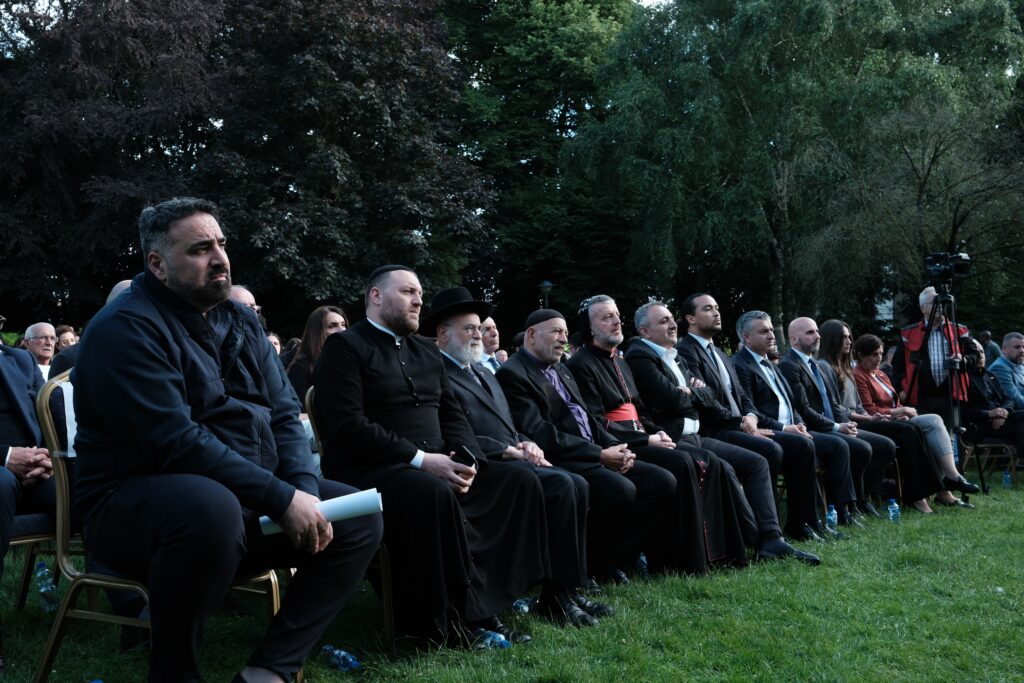
It is now late on Monday evening. I was once again able to attend the annual commemoration at the Volkspark in Enschede of the Genocide against the Arameans that took place in 1915. As I have done for many years, I was able to take part and give a speech. There were more than six hundred people in attendance! Their story, their history, bears such a strong resemblance to our Jewish history. They are Christians who have been persecuted throughout the centuries. Just as I am often complimented on my excellent command of Dutch, they are viewed by the large, uninformed majority of our society as Muslims, whilst it was in fact the Muslims who made their existence impossible, culminating in the genocide of 1915. I would like to make a point here straight away: there is no such thing as ‘the Muslims’. We must not generalise! But the genocide did take place at the hands of the forebears of today’s Turks – though, of course, not at the hands of all factions within Islam! I began my speech by emphasising that I would not open with ‘ladies and gentlemen’, but with ‘Brothers and Sisters’. Applause followed! More than in other years, I felt a sense of solidarity. Their genocide is still being denied. Seventy per cent were murdered. They were the parents of the elderly people present and the grandparents and great-grandparents of the young people. The events took place over a hundred years ago. So these are no longer fresh wounds. But the denial is like a gaping open wound. And that is why I felt even more connected this year. Not because the stories of persecution are virtually identical to our own stories from the years 1940–1945, but because of the denial. Auschwitz is said not to have existed, and the number of Jews gassed and murdered is claimed to be ‘only’ a few hundred thousand, not six million. I felt so at home amongst my ‘brothers and sisters’. The talk given by the great-granddaughter, who described her great-grandfather’s life, was almost identical to the stories of my parents and grandparents (in the Netherlands) and the parents and grandparents of my Blouma in the Soviet Union…
Brothers and sisters: May God bless you!
