
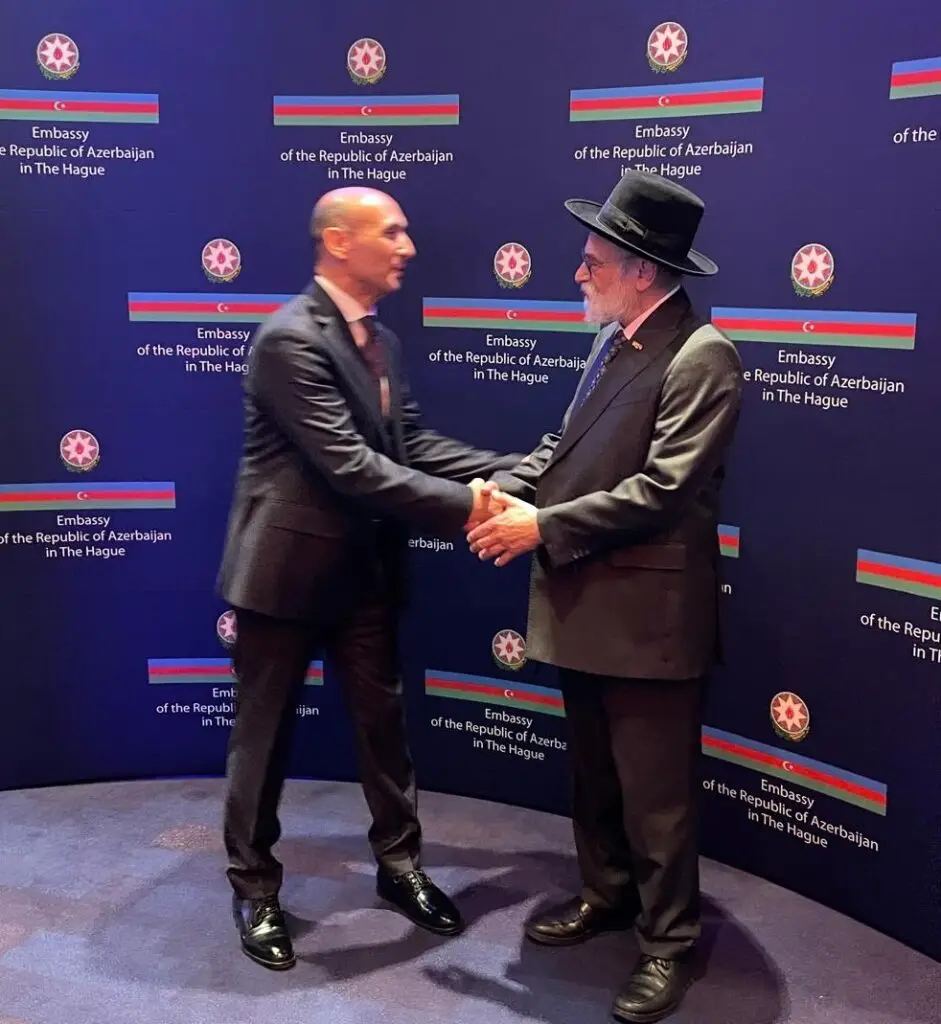
After setting foot on home soil again at 8:00 am on Tuesday morning, I was at the Hilton Hotel in The Hague that evening for the celebration of Azerbaijan’s Independence Day on 28 May. The ambassador is a good friend of mine, so I felt I simply had to be there. Apart from that, and this is of course even more important, Azerbaijan is an Islamic country and at the same time has very good relations with Israel. With God’s help, more Islamic countries will follow! That my presence was appreciated was evident, among other things, from the way I was welcomed. I had barely set foot in the Hilton Hotel The Hague, where the celebration was taking place, when the ambassador’s personal assistant literally came running to meet me to let me in. I therefore felt more than welcome and realise that this welcome is not so much about me personally, but is an outstretched hand towards the Jewish community and thus also towards the State of Israel! One of the guests was Jan van Zanen, The Hague’s mayor, who spontaneously encouraged me by emphatically urging me to continue the fight against anti-Semitism and, above all, not to give up. At the same time, and this was good to hear, he also made it clear that more and more voices are being heard that are speaking out against it and visibly and audibly distancing themselves from the now all-pervasive anti-Semitism. If necessary, he emphasised, I can always reach him on his mobile number!
Having written this down, I was reminded of a dissenting voice that I don’t think I’ve shared with you yet – or perhaps I have, but have forgotten, which wouldn’t surprise me. Exactly two weeks ago, I was visited by Kamran Ullah, the editor-in-chief of De Telegraaf, who clearly presents himself as a friend of Israel. Born and raised in the Netherlands, but because of his Pakistani ancestry and his non-Dutch-sounding first and last names, he is regularly asked whether he speaks Dutch. I immediately felt like a kindred spirit! Because even I, without a first and surname that sounds non-Dutch, was once again asked a few days ago, with the best of intentions, how long I’ve been living in the Netherlands and how long it took me to learn Dutch. I even received a little compliment, as the questioner thought it was very impressive that I spoke Dutch with almost no accent.
And then it was Wednesday, and we set off at 11:00 am, only to set foot on home soil again just now, at 2:00 pm on Thursday 28 May. It was a day and a half in Antwerp. A day and a half doesn’t sound like much, but those 36 hours were very intensive and intense. Meals and the programme at Hoffy’s, staying overnight at Hotel Maek, just 400 metres away. One hundred and fifteen members of the four-hundred-strong business club of Christians for Israel had travelled from all over the Netherlands to Lange Kievitstraat. After being welcomed, the participants were divided into three groups to visit Jewish Antwerp, each in their own way, with their own (quirky) guide. My group – I was one of the three guides – was numerically in the majority. I think the reason for this was that we were all going to visit the yeshiva. Normally, as an outsider, you don’t get in there, because a yeshiva is not a museum where you buy an admission ticket and then, just like at Antwerp Zoo, go and watch (Jewish) monkeys. I had agreed with the director that he would ask the children if they would be willing to sacrifice their playtime – skipping football for once – and instead speak with the guests from the Netherlands, all of whom, without exception, stand unwaveringly and unanimously behind Israel and support many Jewish institutions in Israel with heart and soul. Apart from their substantial financial support, they are also politically active in defending Israel’s interests and fighting against every form of anti-Semitism. There were many new faces, so I had the opportunity to meet many people I didn’t know, though most of them did know who I was, often because of my diary. In the midst of other activities, €95,000 was raised for the restoration and refurbishment of a miklat, or shelter, in Be’er Sheva. It was impressive to see how the boys from the yeshiva struck up conversations with the guests. I had first briefly explained to them what a yeshiva is and then asked them simply to sit or stand next to the students and ask questions. They were allowed to ask anything, and the boys clearly enjoyed the conversations they were able to have and the questions they had to answer.
The Hoffy brothers had provided a fantastic catering service, as usual; everyone was more than satisfied. Naturally, I had the opportunity to address the crowd a few times, but for me, the conversation at the bar that evening was actually the highlight. The questions that came up, the answers I was able to give. Although I didn’t meet a single person from Urk that evening, things turned out completely differently the next morning at breakfast. 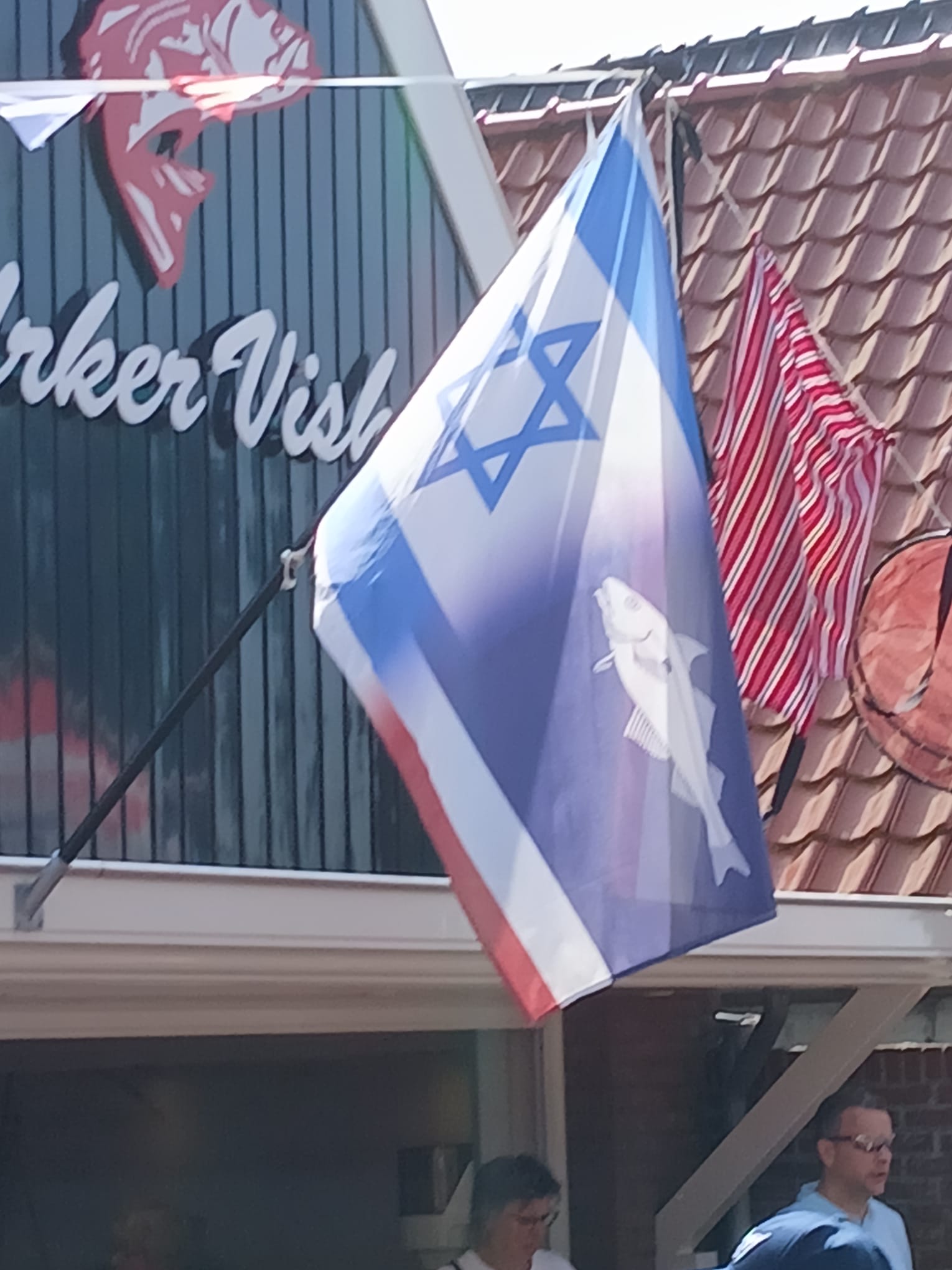 I simply sat down at a table where no one else was sitting, and when I stepped away for a moment and came back, I found myself surrounded by nothing but people from Urk. That the people of Urk sometimes suffer from a (too) high sense of self-importance was evident once again when, without batting an eyelid, one of them told me that: 1) Urk is the capital of the Netherlands, and 2) the sixteen thousand people of Urk form the heart of the Netherlands, where, apart from those sixteen thousand, there are also eighteen million foreigners living. It seems that Urk has now revised its flag, as one of the Urkers told me (or tried to convince me?). It is a standard Israeli flag featuring an image of a fish. The fish, of course, because Urk is a fishing village, although the number of Urk business club members working in the construction industry is very significant and perhaps even exceeds that of the fishmongers.
I’m going to sign off now, as I’m about to be picked up to go to Rotterdam for the first local Rotterdam solidarity walk.
