


There really are people who don’t like me, and one of these non-fans was going around saying that I swim in my spare time and that’s why I write my diaries, as a kind of occupational therapy, just to keep myself busy. I don’t know exactly what is true and what isn’t, but I’ve been so busy the last few days that I’ve even had to skip my occupational therapy. And that’s why I’m late with this diary, which I should have submitted last Thursday, while it’s now already Monday morning. I apologise to my loyal diary readers, a few of whom called to ask if I had stopped writing my diary.
In the meantime, I have been to Belgrade, Vught, Haarlem and Enschede, and in between I also managed to get home. I was in Belgrade for my work at the RCE (Rabbinical Centre of Europe) to help the local rabbis with a halachic task. The RCE is a kind of professional association for rabbis, and where possible we help and advise local rabbis who are on their own and could use some halachic support from a senior rabbi. And although I still consider myself a long way from senior status, I was able to do something for them in this case.
In Haarlem, there was the March of Life, a demonstration in support of Israel and against anti-Semitism. In Enschede, there was the annual commemoration of the Armenian Genocide in 1915. And at the National Monument Camp Vught, Konzentrationslager Herzogenbusch, there was the annual commemoration of the Kindertransports.
Read the words I spoke in Vught for Yizkor, Kaddish and the minute’s silence, and feel the relevance of then to now:
“Ten years ago, I also stood here in front of the children’s monument and warned, like a voice crying in the wilderness, of the rise of anti-Semitism. And while I was expressing my concern, someone rode by on a bicycle, shouting loudly: Heil Hitler. At that time, it was still an exception, but now it is normal.
Two weeks ago, I stood with 250 European rabbis in Auschwitz-Birkenau. The children of the Kindertransports appeared in my mind. If they had not been murdered back then and were still alive today as children, they would be going to a public school and being called cancer Jews. That would be normal. And if they were at a Jewish school, that school would look more like a heavily guarded bunker than a school, and that too would be “normal”. When Jews were rounded up and deported in the 1940s, that was “normal”. And the fact that many of the few who survived hell were not welcome on their return was “normal”.
We are gathered here to commemorate, to warn against the degeneration of the unacceptable into the normal, to fight against the life-threatening polarisation that is simply becoming more and more prevalent in our peaceful Netherlands and which many media outlets are simply contributing to. We say a prayer and implore the Eternal One for peace, shalom, for all inhabitants of His earth, regardless of their faith, race, origin or orientation. But above all, we are gathered here to commemorate and pray for the souls of our children of the Kindertransports, to think exclusively of them, of the indescribable suffering they had to endure before their innocent souls simply left this earthly existence.
In Haarlem, at the March of Life, my main goal was to give the more than three hundred, mainly non-Jewish, participants a boost (or a pat on the back, if you will) and to show them how much we, Jewish Dutch people, appreciate their unconditional support for Israel and their fight against anti-Semitism, and how intensely encouraging we find it.
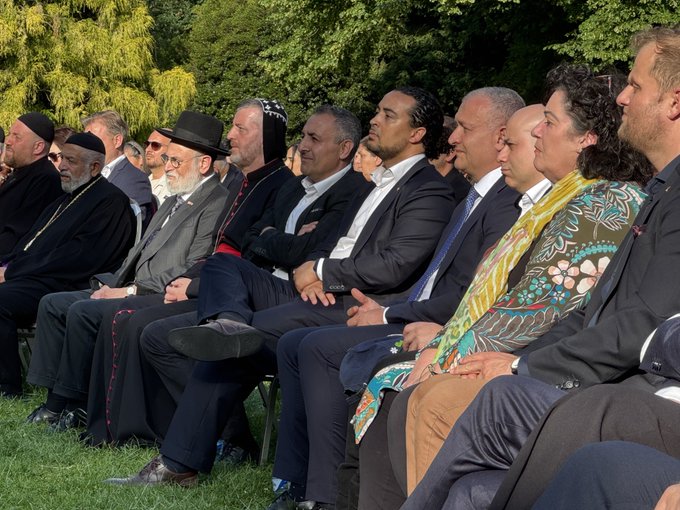 And then, after Haarlem, the annual commemoration of the Arminean genocide in 1915 at the Volkspark in Enschede. It was a perfectly organised event with many good speakers, including Caroline van der Plas. Our House of Representatives has passed a motion recognising the genocide of 1915 by the Young Turks in the Ottoman Empire during the First World War. However, the government refuses to implement this motion and thus recognise the genocide, which is very painful for the Aramenian community. Unfortunately, this is not the first time, as Caroline van der Plas emphasised in her speech, that geopolitical motives have pushed justice into the background. That is why, as I emphasised in my speech, we will continue to commemorate and draw attention to injustices of the past, just as the Holocaust must continue to be commemorated and must not be omitted from history lessons in our schools.
Since I was in Enschede anyway, I couldn’t resist visiting Pieter Omtzigt and his caring and intelligent wife Ayfer at home. I add the word “home” because Pieter and Ayfer were also present at the Volkspark, as usual, and there was actually plenty of opportunity to catch up afterwards. But that didn’t feel enough to me. We were in regular contact via WhatsApp, and now that he is no longer politically relevant, I feel compelled to maintain that contact. I understand his withdrawal from national politics. Politics is not always kosher, as Caroline had pointed out in her speech earlier, and dealing with that is difficult and often borders on the edge of what is ethically acceptable. Politics is everywhere: in academic hospitals, in the banking world, in education, in real estate, in industry, in religious communities… everywhere. And even in the world of rabbis.
But in real politics, the pinnacle of politics, everyone and everything is political. You need to have a thick skin and be willing to look away more than once.
The stance taken by a number of Dutch mayors today smacks of deliberately closing their eyes to import a conflict from elsewhere, Gaza-Israel, into their municipal boundaries… Unnecessary, counterproductive and harmful!
I understand why Pieter has withdrawn, however much I regret it. But if I understand correctly…
